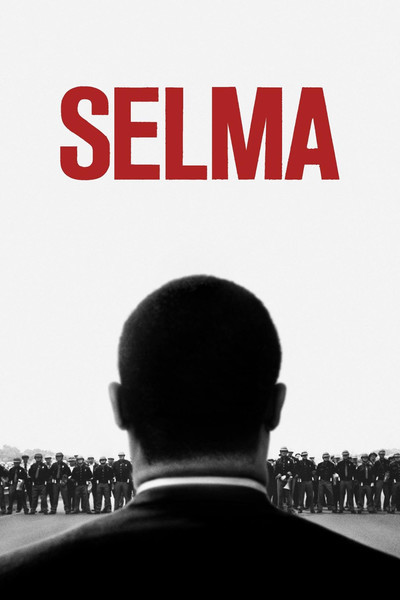
 Now I actually knew very little about what happened in Selma in 1965, and its impact on the civil rights movement, and very little about the film itself. I thought it was a biopic about King's wife, and was confused when they mentioned that they were in Selma and his wife's name was revealed not to be Selma. Anyway, this is an important film to watch because we see a significant historical event on screen: Martin Luther King Jr. leading a dangerous campaign to secure equal voting rights. It's fitting that Selma came out this year, as it's the 50th anniversary of the event. Note that this film is mainly about what happened in Selma (hence the title), and isn't really a Martin Luther King biopic, as I've heard many say, so if you're looking for a film that's only about Dr. King then you may have to look for another film to watch.
The movie starts off in a shocking way. I don't want to give anything away, but I wasn't expecting the events of the opening scene happen., The initial scene focuses on characters going about their normal lives, and then the next minute there's devastation. Ava DuVernay, the director of the film, first uses slow-motion here. I found the slow-motion aspect interesting, and and it actually became one of my favourite things about the film. However, I think after this scene the pace did tend to lag that I thought about taking a break from the film to do something else. But, I'm glad I didn't do that because the best part of the film is its second half.
As I said, one of my favourite things about the film was the use of slow motion shots. We don't normally see this historical films, so to see this in Selma was intriguing, but it definitely fit in and was one of the film's strengths, in my opinion. It was used wisely in the violent and dramatic scenes and wasn't overdone. You got to fully see the devastating effects of these terrible acts, and in a way, the use of slow motion made those scenes filled with violence more emotional, and gave the audience time to think and reflect on it. I know that when I saw those scenes I kept on thinking 'why is this happening?', 'could this really have happened 50 years ago?', 'this is terrible' and remembered them more vividly than the other scenes without slow motion.
However, these scenes were also great because of the music, which is another strength of the film. Whether it was Mahalia Jackson (played by Ledisi) singing or the beautiful score by Jason Moran, the music was moving and certainly made me emotional. The music was on point, it definitely truly reflected the time period and the music that helped black civil rights groups cope during hard times,. It also made those tragic violent scenes even more tragic. I found the scene at the end extremely moving as well, mainly because of the music. Yes, David Oyelowo who plays King, was giving a very emotional, powerful and moving speech, but without the music, the final scene would not have been that great. The music for the ending credits (Glory by Common and John Legend) was powerful in another way too, because it mentioned Ferguson which is appropriate given the subject of the film.
 Speaking of Ferguson. In this film we see mirror images of what happened last year in Ferguson. For example, there is a scene which shows a lot of police brutality as the police officers try and stop the black people from marching for their right to vote. I think this was one of my favourite scenes, besides the final scene, as it did really remind me of Ferguson and similar protests. It was terrible and heartbreaking to watch, and showed that not much has changed in 50 years, because it looked almost like what is happening now. The way the police treated the characters in the film enraged me. We saw police officers beating up men and even women, and in one of the saddest scenes in the film, which yet again featured excellent music, we saw a police officer shoot a young black man involved in the marches point blank in front of his family. The violence isn't only carried out by the police, but also normal citizens. We see white clergymen marching with them, and later being brutally attacked for doing so. Although, the scenes in which black people were attacked affected me more, watching innocent clergyman being attacked for supporting a right cause perturbed me.
There are a lot of familiar faces in the film, who give some great performances. However, I think that David Oyelowo was slightly miscast here as MLK. There was something about his performance that didn't scream Martin Luther King to me; it just it wasn't convincing. I've seen at least one other actor who was more of a Martin Luther King, than Oyelowo was, but his acting wasn't bad. I think he tried his best.
As I've mentioned, I really enjoyed the end scene as it contained a powerful speech by Dr. King, accompanied by excellent music. We also got to see what happened to many of the characters in the film after black people were given the right to vote, during this powerful and moving speech, which I think made the revelation of what happened to certain people more impactful. What also gave more power to the scene was that we also see real footage of the events that took place in Selma in the film at the end, It was beautiful to see.
Even though I thought it as a little slow at times, and thought that I was not going to like it, I enjoyed it as a film overall. It could have been better, but I'm glad this film was made because I learnt a lot while watching it and it contained some moving scenes. I recommend watching it to gain more insight into what happened at Selma, and to gain more context about what's happening in places all over the USA, like Ferguson.

No hay comentarios:
Publicar un comentario